Cooking Guide
How to Bake Sweet Potatoes
Oven times by size and temperature, what foil really does to the texture, and the doneness test that beats guessing.
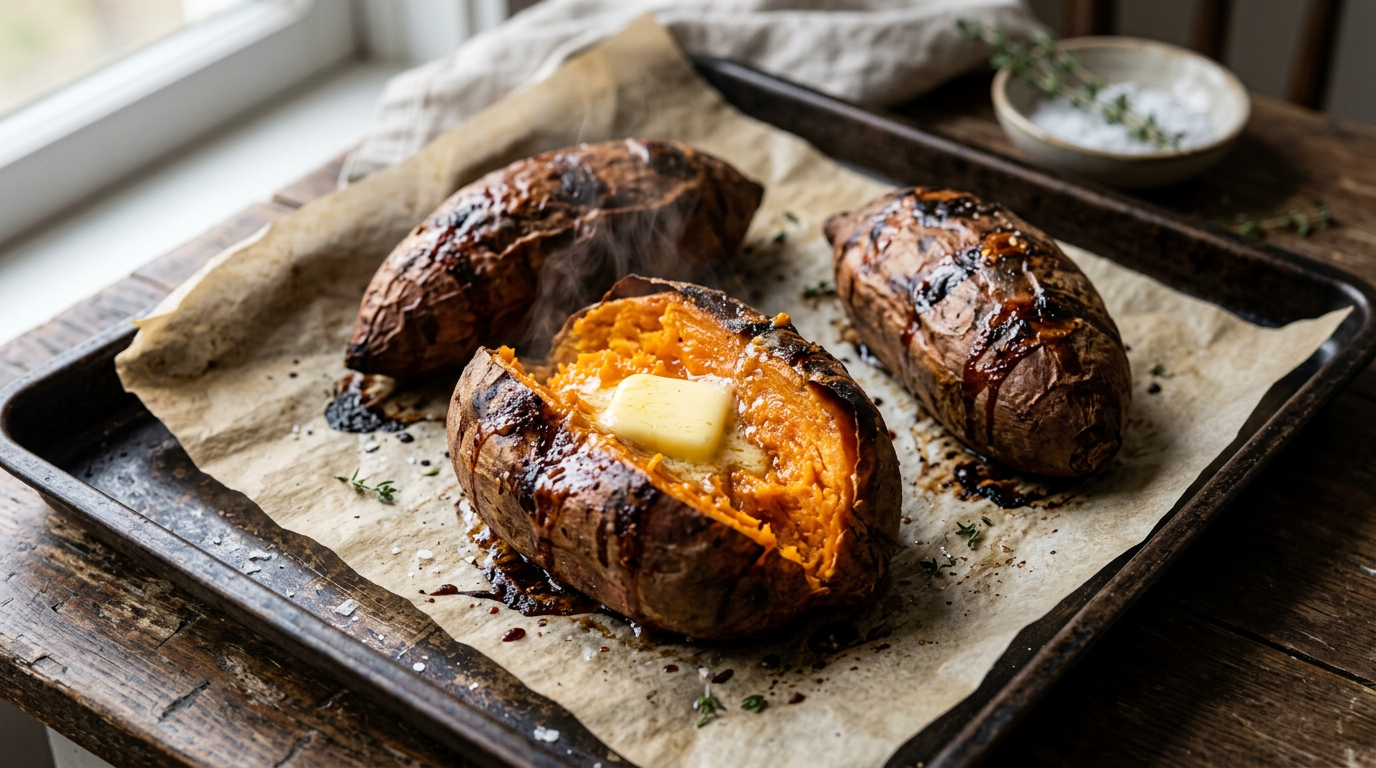
A good baked sweet potato needs three things and none of them are complicated: a hot oven, enough time, and nothing wrapped around it. What people usually get instead is either a pale wet potato that tastes like plain starch, or a shrivelled one with stringy flesh that went twenty minutes too far.
The sweetness is not something you add. Sweet potatoes carry enzymes that break their starch down into sugar while the flesh heats, and those enzymes work in a window on the way up to done. A slower bake spends longer in that window, which is why a potato baked at 375°F tastes noticeably sweeter than the same potato blasted at 450°F.
Foil is the other decision. It traps steam and gives you soft, mild, evenly cooked flesh with no caramelization. Bare potatoes lose water, concentrate their sugars, and leave that dark syrup on the pan. Both are fine results, but they are not the same dish.
The chart and method below cover whole potatoes, halves, and cubes, with fixes for the ways a tray goes wrong.
Baking times by size and temperature
Times assume a fully preheated oven and potatoes spaced apart on a rack. Start testing at the low end of each range.
| Potato | Oven | Time |
|---|---|---|
| Small, 5 to 6 oz | 425°F / 220°C | 35–45 minutes |
| Medium, 8 oz | 425°F / 220°C | 45–55 minutes |
| Large, 10 to 12 oz | 425°F / 220°C | 55–70 minutes |
| Medium, slower and sweeter | 375°F / 190°C | 60–75 minutes |
| Halved lengthwise, cut side down | 425°F / 220°C | 25–35 minutes |
| Cut into 1 in cubes | 425°F / 220°C | 25–30 minutes |
The 8-step method
- 1.
Heat the oven and line a sheet pan
Set the oven to 425°F and let it come fully up to temperature. Line a rimmed sheet pan with parchment or foil, because sweet potatoes leak sugary syrup that bakes onto bare metal.
- 2.
Pick potatoes of a similar size
Choose firm potatoes with smooth skins and no soft spots. Matching their size matters more than the exact weight, since a small one next to a large one means one is done long before the other.
- 3.
Scrub and dry the skins
Rinse under cool water and scrub away grit with a brush, then dry them well. A dry skin crisps instead of steaming, and the skin is edible once baked.
- 4.
Pierce, oil, and salt
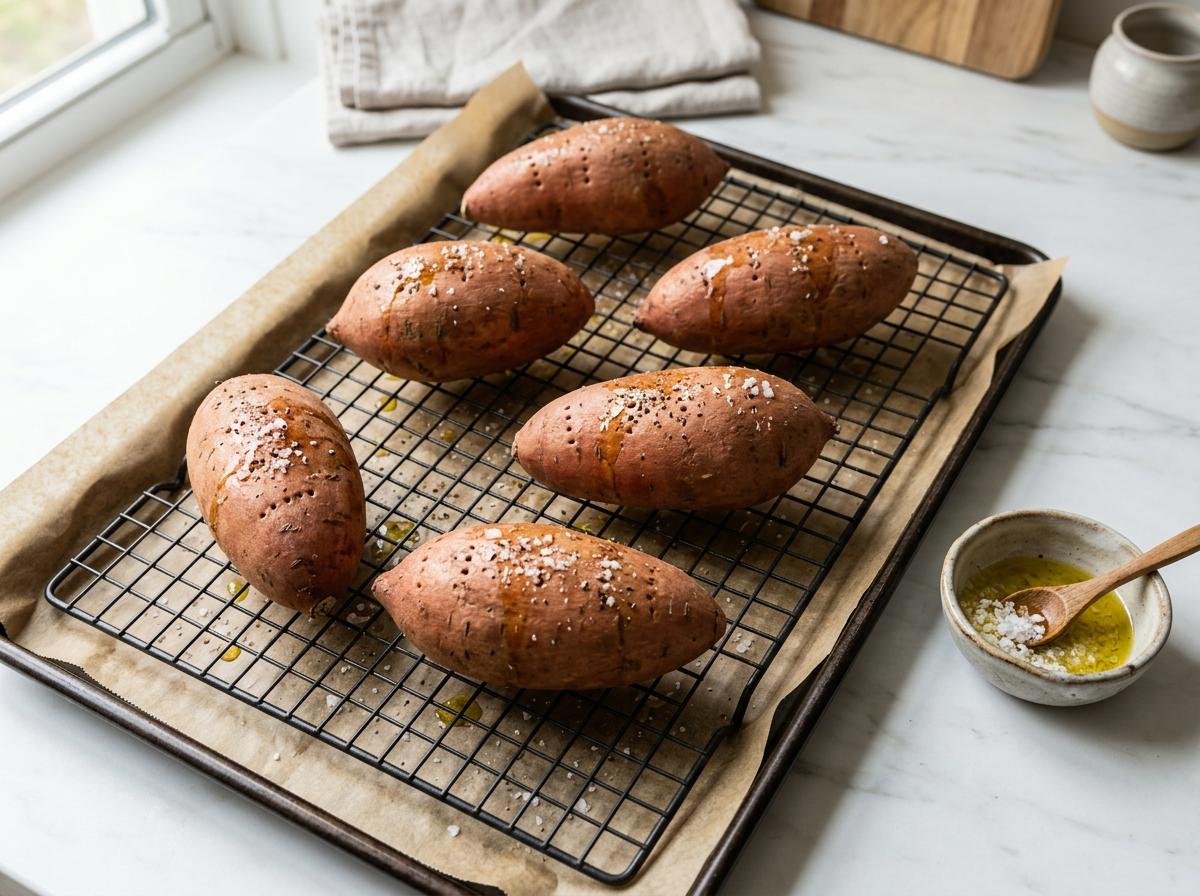
Prick each potato four or five times with a fork so steam can escape. Rub lightly with a neutral oil or olive oil and season the outside with salt for a skin that tastes worth eating.
- 5.
Bake directly on the rack over the pan
Set the potatoes on a wire rack over the lined sheet pan, or straight on the pan with space between them. Air moving around the whole potato keeps the underside from turning flat and wet.
- 6.
Skip the foil if you want caramelized edges
Wrapping in foil traps steam and gives you a softer, paler result closer to a steamed potato. Bare potatoes lose moisture, concentrate their sugars, and develop the dark syrup that pools on the pan.
- 7.
Test with a knife, not the clock
Start checking at the low end of the range in the chart. A thin knife or skewer should slide into the thickest part with no resistance, and the potato should feel slack when you squeeze it with a towel.
- 8.
Split them and let steam escape
Cut a slit down the length of each potato as soon as it comes out. The trapped steam escapes instead of soaking back into the flesh, which keeps the texture fluffy rather than wet.
Foil, no foil, or halved
Bare on a rack is the default for a fluffy interior and skin worth eating. Foil is useful when you want a uniformly soft potato for mashing into a filling, a soup, or a batter, since the flesh stays wetter and easier to scoop. Halving lengthwise and laying the cut side down on an oiled pan is the fastest route, and the flat face browns into a caramelized crust in under 35 minutes.
Cubes behave differently again. At 425°F they roast rather than bake, with crisp edges and a soft middle, which is the shape you want for grain bowls and trays alongside baked chicken thighs or a pot of simmered lentils.
Four habits that improve every tray
- A longer bake at a lower temperature gives a sweeter potato, because the enzymes that convert starch to sugar keep working while the flesh climbs slowly through their active range.
- Bake one or two extra. Cold baked sweet potato mashes into pancakes, soup, and muffin batter without any extra work.
- If the skin is your favorite part, brush on a second thin coat of oil halfway through and finish under the broiler for a minute.
- Use a rack. It is the single easiest change between an evenly baked potato and one with a soggy flat side.
Fixing a tray that went wrong
Match the symptom to the cause and the next tray comes out right.
Dry and stringy flesh
Baked well past tender, usually at high heat for a long time. Test earlier and pull them as soon as a knife slides in freely.
Watery and bland
They were wrapped in foil, so the steam had nowhere to go. Bake them bare and split them straight out of the oven.
Firm center, soft ends
The potato was very thick in the middle. Halve thick potatoes lengthwise and lay them cut side down.
Not sweet enough
The oven was too hot to let the starch convert. Try 375°F for 60 to 75 minutes instead.
Burnt sugar smoking in the oven
Syrup dripped onto the oven floor. Always bake over a lined pan.
Some done, some raw
Mixed sizes on one pan. Sort by size and bake similar potatoes together.
What is in a baked sweet potato
Per 100 g of flesh, baked in the skin without salt, from USDA FoodData Central (FDC ID 168483).
Calories
90 kcal
Carbohydrate
20.7 g
Fiber
3.3 g
Protein
2.01 g
Fat
0.15 g
Potassium
475 mg
Vitamin A (RAE)
961 µg
Vitamin C
19.6 mg
Storing, freezing, and reheating
Cool baked sweet potatoes promptly and refrigerate them in a covered container rather than leaving them out on the counter. To reheat, warm them in a 350°F oven until hot through, which brings back some of the skin texture that a microwave softens.
For the freezer, scoop the cooked flesh, mash it, and freeze it in portions. It thaws well into soups, muffin batters, and pancakes. Store raw sweet potatoes somewhere cool, dark, and dry with air movement, not in the refrigerator, where cold turns their texture hard and their flavor flat.
Baked Sweet Potato FAQs
How long do you bake sweet potatoes at 425°F?
A medium 8 oz sweet potato takes 45 to 55 minutes at 425°F, small ones take 35 to 45 minutes, and large ones can need up to 70 minutes. Confirm with a knife rather than the clock.
How long do you bake sweet potatoes at 400°F?
Expect roughly 50 to 65 minutes for a medium potato at 400°F. Lower heat means a longer bake and a slightly sweeter, softer result.
Should you wrap sweet potatoes in foil?
Only if you want a soft, pale, steamed texture. Baking them bare lets moisture leave, concentrates the sugars, and gives you caramelized skin and darker syrup.
Do you need to poke holes in sweet potatoes before baking?
Yes, prick each one four or five times with a fork. The holes let steam vent so the potato does not split unevenly or burst in the oven.
How do you know when a baked sweet potato is done?
A thin knife or skewer should pass into the thickest part with no resistance, the potato should feel soft when squeezed through a towel, and syrup usually beads at the ends.
How should you store baked sweet potatoes?
Refrigerate them in a covered container once they have cooled rather than leaving them at room temperature. Reheat in a 350°F oven until hot through, or freeze the cooked flesh mashed for later use in soups and batters.
Sources and further reading
Keep cooking
Put a tray of sweet potatoes to work with any of these guides and recipe collections.